參數資料
| 型號: | C8051F016 |
| 廠商: | Silicon Laboratories Inc |
| 文件頁數: | 37/171頁 |
| 文件大小: | 0K |
| 描述: | IC 8051 MCU 32K FLASH 48TQFP |
| 標準包裝: | 250 |
| 系列: | C8051F01x |
| 核心處理器: | 8051 |
| 芯體尺寸: | 8-位 |
| 速度: | 25MHz |
| 連通性: | SMBus(2 線/I²C),SPI,UART/USART |
| 外圍設備: | 欠壓檢測/復位,POR,PWM,溫度傳感器,WDT |
| 輸入/輸出數: | 16 |
| 程序存儲器容量: | 32KB(32K x 8) |
| 程序存儲器類型: | 閃存 |
| RAM 容量: | 2.25K x 8 |
| 電壓 - 電源 (Vcc/Vdd): | 2.7 V ~ 3.6 V |
| 數據轉換器: | A/D 8x10b; D/A 2x12b |
| 振蕩器型: | 內部 |
| 工作溫度: | -40°C ~ 85°C |
| 封裝/外殼: | 48-TQFP |
| 包裝: | 托盤 |
第1頁第2頁第3頁第4頁第5頁第6頁第7頁第8頁第9頁第10頁第11頁第12頁第13頁第14頁第15頁第16頁第17頁第18頁第19頁第20頁第21頁第22頁第23頁第24頁第25頁第26頁第27頁第28頁第29頁第30頁第31頁第32頁第33頁第34頁第35頁第36頁當前第37頁第38頁第39頁第40頁第41頁第42頁第43頁第44頁第45頁第46頁第47頁第48頁第49頁第50頁第51頁第52頁第53頁第54頁第55頁第56頁第57頁第58頁第59頁第60頁第61頁第62頁第63頁第64頁第65頁第66頁第67頁第68頁第69頁第70頁第71頁第72頁第73頁第74頁第75頁第76頁第77頁第78頁第79頁第80頁第81頁第82頁第83頁第84頁第85頁第86頁第87頁第88頁第89頁第90頁第91頁第92頁第93頁第94頁第95頁第96頁第97頁第98頁第99頁第100頁第101頁第102頁第103頁第104頁第105頁第106頁第107頁第108頁第109頁第110頁第111頁第112頁第113頁第114頁第115頁第116頁第117頁第118頁第119頁第120頁第121頁第122頁第123頁第124頁第125頁第126頁第127頁第128頁第129頁第130頁第131頁第132頁第133頁第134頁第135頁第136頁第137頁第138頁第139頁第140頁第141頁第142頁第143頁第144頁第145頁第146頁第147頁第148頁第149頁第150頁第151頁第152頁第153頁第154頁第155頁第156頁第157頁第158頁第159頁第160頁第161頁第162頁第163頁第164頁第165頁第166頁第167頁第168頁第169頁第170頁第171頁
C8051F000/1/2/5/6/7
C8051F010/1/2/5/6/7
18.1.
UART Operational Modes
The UART provides four operating modes (one synchronous and three asynchronous) selected by setting
configuration bits in the SCON register. These four modes offer different baud rates and communication protocols.
The four modes are summarized in Table 18.1 below. Detailed descriptions follow.
Table 18.1. UART Modes
Mode
Synchronization
Baud Clock
Data Bits
Start/Stop Bits
0
Synchronous
SYSCLK/12
8
None
1
Asynchronous
Timer 1 or Timer 2 Overflow
8
1 Start, 1 Stop
2
Asynchronous
SYSCLK/32 or SYSCLK/64
9
1 Start, 1 Stop
3
Asynchronous
Timer 1 or Timer 2 Overflow
9
1 Start, 1 Stop
18.1.1. Mode 0: Synchronous Mode
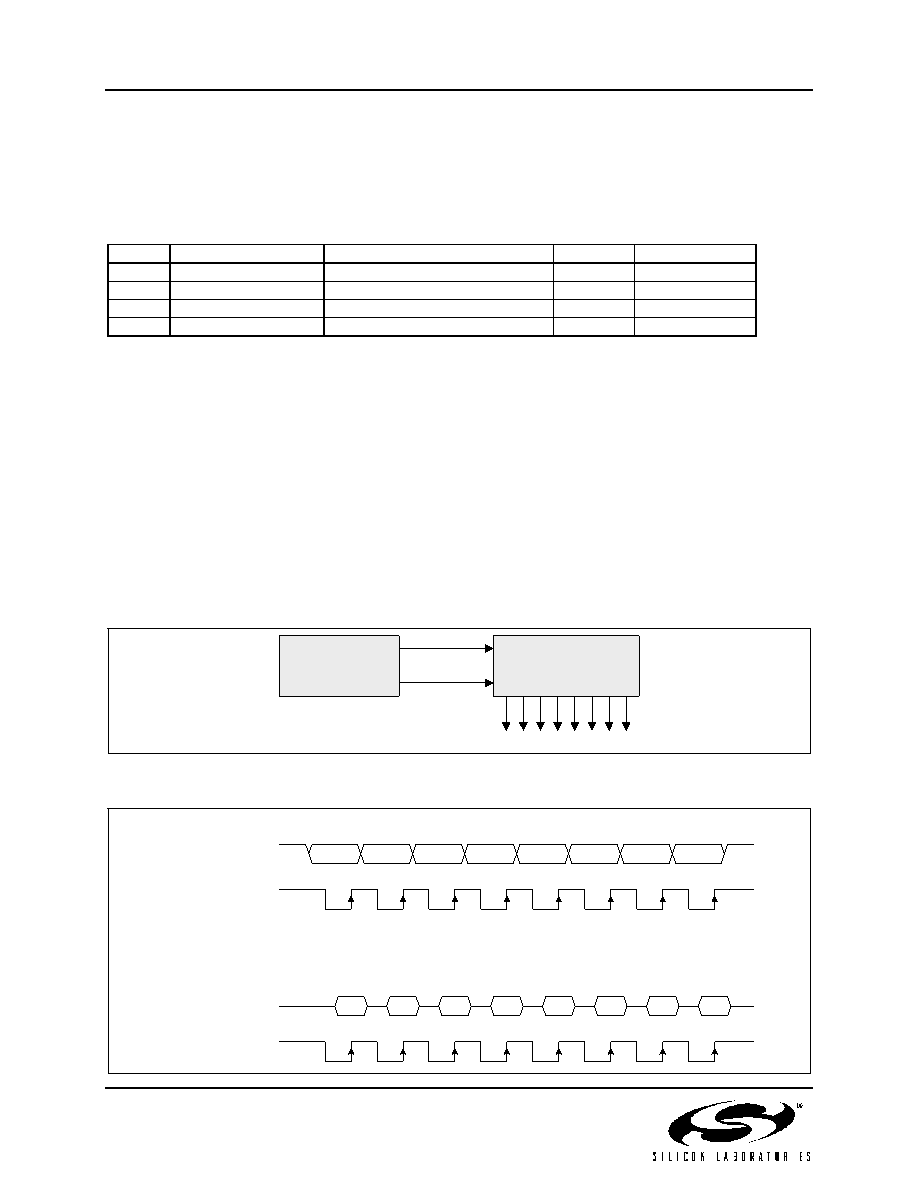
Mode 0 provides synchronous, half-duplex communication. Serial data is transmitted and received on the RX pin.
The TX pin provides the shift clock for both transmit and receive. The MCU must be the master since it generates
the shift clock for transmission in both directions (see the interconnect diagram in Figure 18.2).
Eight data bits are transmitted/received, LSB first (see the timing diagram in Figure 18.3). Data transmission begins
when an instruction writes a data byte to the SBUF register. The TI Transmit Interrupt Flag (SCON.1) is set at the
end of the eighth bit time. Data reception begins when the REN Receive Enable bit (SCON.4) is set to logic 1 and
the RI Receive Interrupt Flag (SCON.0) is cleared. One cycle after the eighth bit is shifted in, the RI flag is set and
reception stops until software clears the RI bit. An interrupt will occur if enabled when either TI or RI is set.
The Mode 0 baud rate is the system clock frequency divided by twelve. RX is forced to open-drain in mode 0, and
an external pull-up will typically be required.
Figure 18.2. UART Mode 0 Interconnect
Shift
Reg.
CLK
C8051Fxxx
RX
TX
DATA
8 Extra Outputs
Figure 18.3. UART Mode 0 Timing Diagram
18.1.2. Mode 1: 8-Bit UART, Variable Baud Rate
D1
D0
D2
D3
D4
D5
D6
D7
RX (data out)
MODE 0 TRANSMIT
D0
MODE 0 RECEIVE
RX (data in)
D1
D2
D3
D4
D5
D6
D7
TX (clk out)
131
Rev. 1.7
發布緊急采購,3分鐘左右您將得到回復。